¶ Selection of Inner Carved Glass and Refractive Index Calculation
¶ 1. Selection of Glass Material
The types of glass in daily life are actually more numerous than imagined, especially in fields such as glassware, wine utensils, crystal crafts, lighting fixtures, and architectural glass. Classified by material composition, the following common types of glass can be listed:
¶ 1. K9 Glass
Main Components: SiO₂, B₂O₃, Na₂O, optical glass according to Chinese standards, corresponding to overseas BK7
Common Products: Laser Inner Carved Crystal Ball, Crystal Trophy, Optical Prism, LED Lens
Refractive Index: 1.52
Internal carving performance: Currently the main material in the laser internal carving industry, with a uniform point cloud, high whiteness, high contrast, and extremely low risk of cracking.
Recommendation Rating: ⭐⭐⭐⭐⭐
¶ 2. K5 Glass
Main components: SiO₂, K₂O, Na₂O, etc.,
Common products: optical window, vintage camera lens, etc.
Refractive Index: 1.52
Internal carving performance: Similar to K9, with good optical uniformity.
Recommendation Rating: ⭐⭐⭐⭐⭐
¶ 3. Lead-free crystal glass
Main Components: SiO₂, BaO (Barium Oxide), ZnO (Zinc Oxide), K₂O (Potassium Oxide)
Common Products: Wine Glass, Whiskey Glass, High-end Handicrafts
Refractive Index: 1.53~1.58
Internal carving performance: Commercial internal carving products are widely used in trophies, souvenirs, crystal ornaments. During internal carving, the explosion points are evenly distributed, with high contrast and low susceptibility to cracking.
Recommendation Rating: ⭐⭐⭐⭐
¶ 4. Borosilicate glass (commonly known as heat-resistant glass)
Main Components: SiO₂, B₂O₃ (Boron Oxide)
Common Products: Heat-resistant glass cups, teapots, coffee pots, laboratory ware, oven glass
Refractive Index: 1.47
Internal carving performance: The laser breakdown threshold is relatively high, the whitening effect of internal carving points is average, microcracks are not obvious, contrast is insufficient, and the ornamental value is relatively poor.
Recommendation Rating: ⭐⭐⭐
¶ 5. Lead glass
Main Components: SiO₂, PbO (Lead Oxide)
Common Products: Crystal Ornaments, Crystal Lighting, Trophies
Refractive Index: 1.6~1.8
Internal carving performance: During internal carving, star-shaped cracks, large-area chipping, and local cracking after long-term processing are prone to occur.
Recommendation Rating: ⭐⭐⭐
¶ 6. Soda-lime glass
Main Components: SiO₂ (Silicon Dioxide) ≈ 70%, Na₂O (Sodium Oxide), CaO (Calcium Oxide)
Common Products: ordinary glass cups, beer bottles, beverage bottles, window glass, picture frame glass, glass jars
Refractive Index: 1.51~1.52
Internal carving performance: More bubbles, obvious streaks, poor uniformity, prone to crack propagation, and uneven brightness at processing points.
Recommendation Rating: ⭐⭐
¶ 7. Fused Quartz
Main Component: SiO₂ of Extremely High Purity
Common Products: UV Laser Windows, Laser Lenses, Semiconductor Equipment, etc.
Refractive Index: 1.46
Internal carving performance: The laser damage threshold is extremely high, making it difficult to form obvious white spots, resulting in poor contrast.
Recommendation Rating: ⭐⭐
¶ 8. Tempered Glass
Main Components: Tempered glass itself is not a new glass material but a heat treatment process. Therefore, its refractive index mainly depends on the material of the original glass rather than the tempering process. The common substrate is soda-lime glass,
Common Products: Mobile phone covers, automobile side windows, glass tabletops, etc.
Refractive Index: Consistent with the substrate, approximately 1.52 when the substrate is soda-lime glass
Internal carving performance: The tempered layer has residual stress, which makes it prone to cracking during carving, leading to the explosion of the entire glass panel, and is the least recommended.
Recommendation Level: ❌
¶ 9. Summary
Based on the above materials, the recommended glass materials for users to perform laser internal engraving are lead-free crystal glass, K9 glass, and K5 glass, all of which have a refractive index around 1.52. Therefore, when it comes to internal engraving of irregular or spherical materials, it is better to choose a liquid with a refractive index closer to 1.52. At the same time, non-toxicity and low cost also need to be considered.
¶ 2. Refractive Index Calculation
¶ 2.1 Refractive Index (abbreviated as n)
is an important physical quantity that describes the speed of light propagation in a material. It is defined as:

Where:
c: The speed of light in a vacuum is approximately 3×10⁸ m/s
v: The propagation speed of light in a medium
The larger the refractive index, the slower light propagates in the material.
¶ 2.2, Refraction Phenomenon
When light passes from one medium into another, due to the change in propagation speed, the direction of light propagation will deviate, and this phenomenon is called refraction. For example:
Air → Water
Air → Glass
Glass → Water
will all produce refraction.
Its law is described by Snell's law:
n1 sin θ1=n2 sin θ2
Where:
n1, n2: refractive indices of two media
θ1, θ2: Angle of incidence and angle of refraction
Refractive indices of common materials:
| Material | Refractive Index (589nm) |
| Vacuum | 1 |
| Air | 1.0003 |
| Water | 1.333 |
| Quartz glass | 1.458 |
| K9/BK7 Glass | 1.517 |
| Lead-free crystal glass | 1.52~1.58 |
| Lead Crystal Glass | 1.60~1.75 |
| diamond | 2.42 |
¶ 2.3. Refractive index is related to wavelength
The refractive index is not a fixed value but varies with wavelength, and this phenomenon is called dispersion .
Generally, the longer the wavelength, the smaller the refractive index, for example
n355nm>n532nm>n1064nm
That is to say:
Ultraviolet light (355nm) has the highest refractive index
Green light (532nm) comes next
Infrared light (1064nm) is the lowest
Taking K9 glass as an example:
| Wavelength | Refractive Index |
| 355nm | ≈1.539 |
| 532nm | ≈1.519 |
| 589nm | ≈1.517 |
| 1064nm | ≈1.506 |
¶ 2.4. Influence of Refractive Index in Laser Processing
For the customer's current 355nm laser internal engraving application scenario, the refractive index mainly affects:
Focus Position: The focal point will change with the refractive index of the material.
Spherical aberration magnitude:Refractive index error affects focusing quality.
Depth of focus after the laser enters the material: The actual depth of focus differs from the calculated value in air.
Interface reflection loss: Each uncoated surface will cause a loss of some energy.
Therefore, different materials have different refractive indices, and accordingly, their laser focusing positions are different. Below are several methods for obtaining refractive indices.
¶ 2.5. Method for Obtaining the Magnitude of Refractive Index
When the material is known, the refractive index of the material can be directly searched on the website.
When the material is unknown, it can be obtained by comparing it with materials of known refractive indices.
Auxiliary Engraving Measurement Method
For internal glass engraving / focal marking, the refractive index can be estimated based on focal point displacement:
- Height of the first internal engraving pattern: h1
- Height of the second internal engraving pattern after Z-axis movement: h2
- Z-axis travel distance: z
Refractive index formula: n =( h2 - h1 )/ z
Example
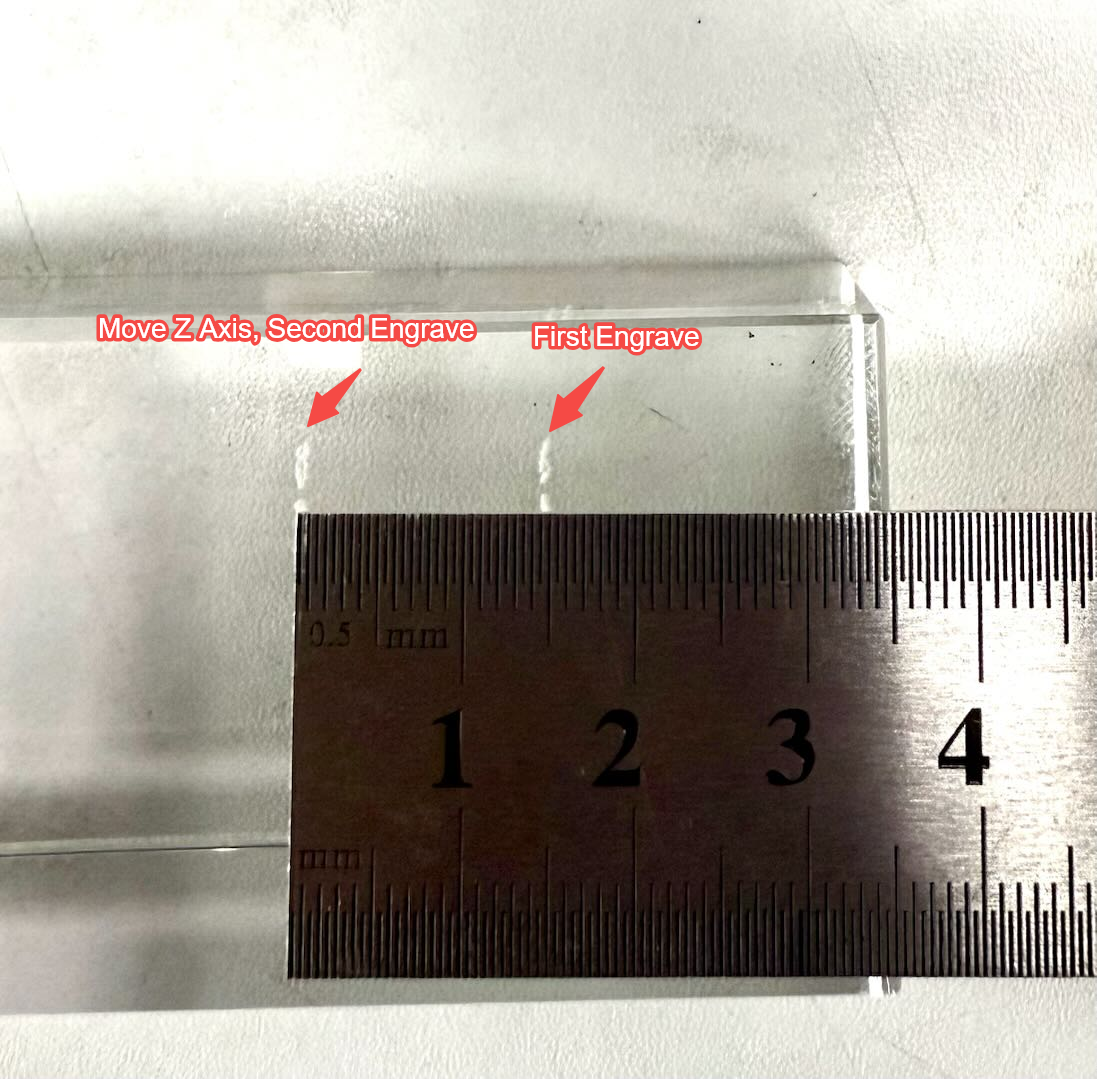
A crystal blank with total height of 50mm
- First engrave a planar pattern at an internal height of 20mm
- Raise the Z-axis by 10mm and perform the second engraving at an internal height of 35.2mm
Calculate refractive index: n = (35.2-20) / 10 = 1.52
FFocus Compensation Method
Assume that the laser is incident vertically on the K9 sample and the sample to be measured. The thicknesses of the K9 sample and the sample to be measured are denoted by a and b respectively, which can be measured using a vernier caliper or a ruler and are taken as known quantities.
When the laser is focused on the bottom surface of the K9 sample, the optical path at this time can be obtained as: OPL1 = z1 + n1 a
When the laser is focused on the bottom surface of the sample to be measured, the optical path at this time can be obtained as :OPL2 = z2 + n2 b
z1 and z2 represent the distances from the laser to the upper surface of the sample, respectively. By adjusting z2, when the laser is focused on the bottom surface in both cases, we can obtain OPL1 = OPL2.
Then, after simplification, we obtain:
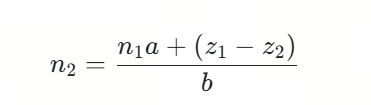
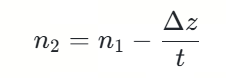
If the material thickness is the same, denoted as t, then the above equation can be simplified to
Thickness Offset Measurement Method via Microscope
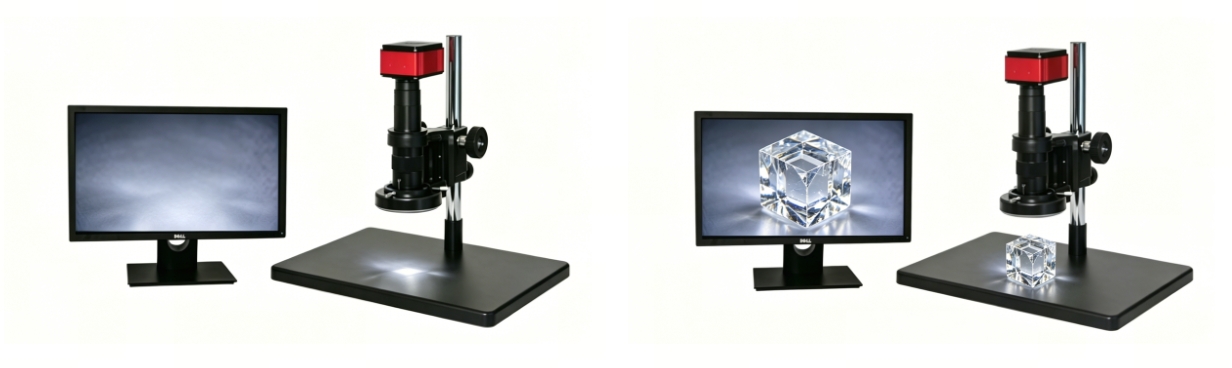
If the glass features parallel surfaces, the actual physical thickness is defined as d.
Under the microscope, first focus on the top surface and record the position of the objective lens (or stage) as z1. Next, refocus on the bottom surface and record the corresponding objective/stage position as z2. The refractive index is calculated by the formula: n = d / z1 - z2
Example
True physical thickness d = 10 The travel distance of the microscope between focusing on the top and bottom surfaces is n = 10 / 6.6 = 1.515
Measurement Notes
Keep the microscope perpendicular to the sample during testing. Ensure sharp, precise focus at each step to minimize measurement error and improve the accuracy of refractive index calculation.